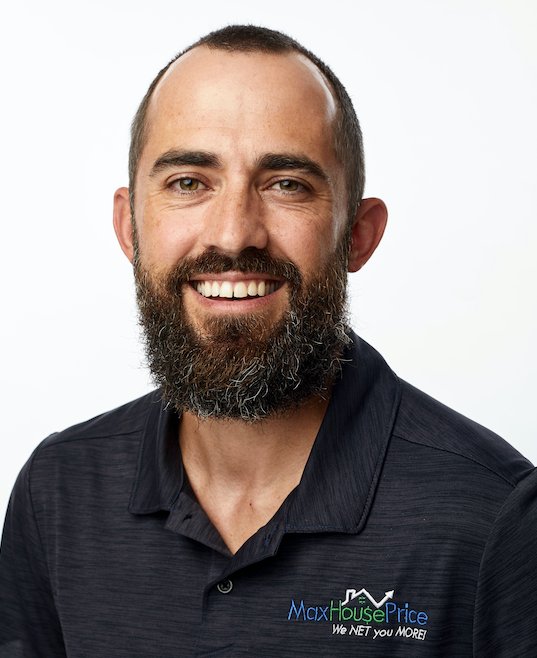
Start here.
Here's what you get on this site: the speed of AI without the mess. The habits I actually use to run my company, one at a time, ten minutes each, with the exact words to paste. They work in ChatGPT, Gemini, Copilot or Claude. Free. No course.
And here's what I promise: I'll show you what I'm actually doing.* What's working, what broke, what I changed. Not the highlight reel.
*Everything I show you is a tool I use. The names, addresses and numbers in the demos are made up, to protect my clients and my team.
Why I'm sharing this
I didn't set out to write about AI. Friends, family and other business owners kept asking how I do it, and I kept answering one person at a time. So I decided to write it down, out loud, as I go.
I co-run a renovation company from about 370 miles away. For a while now AI has been how I keep up with it: the morning plan, the messy voice notes turned into clean lists, the apps I built without being a developer. Most people have only met AI as a chatbot. Someone who runs a company with it should show the honest version, limits and all. And plain guides from other people got me here, so this is me paying that forward.
Writing it in public does one more thing. Practice what you preach. If you know me, you know those aren't words I throw around. If I say a habit out loud, I have to keep doing it, and I have to check my own practice every week instead of just talking about it. It keeps me honest.
There's a new AI tool every week. A new model, a new trick, a new "this changes everything." If you feel behind, I've felt it too. Here's what I've learned using AI in my company: you don't need to keep up. You need to keep going.
Why "done right"
AI gives you 10x the speed. Skip the foundation, and you get 10x the mess.
Speed is easy now. What's hard is speed that holds up: work you can check, files you can find, rules your AI follows every time, and a pace you can keep without burning out.
That's what AI Done Right means to me:
- Rules before tools. Tell it who you are and what it must never do before you ask it for anything.
- A few tools, used well. The one you already have, used on purpose. I don't chase AI. I run a company with it, and I share what sticks.
- Check before it goes out. You stay the one who says yes.
- Your data, your call. Know what it keeps, and choose on purpose.
- A steady pace. One habit at a time. Calm, and never behind.
How this works
This is the start of a four-part series. I'm writing it as I go, from how I actually run my company using AI, so it will grow as I do. Part 1 is up now: Start right. Four habits, a starter kit you keep, and one exercise so you can tell you've got it. No setup beyond the app you already have. Parts 2, 3 and 4 are coming: working well before working fast, connecting your real work (mail, files, calendar), and handing off carefully (agents, your team, a real build). Each one comes when it's ready, and I'll say so here and on my pages. No dates, on purpose. It's a marathon.
Every habit post has three levels: Beginner (about 10 minutes), Intermediate (about 15) and Advanced (about 20). Every step has a prompt you can paste, marked Paste this:, and a note on where things live in ChatGPT, Gemini, Copilot or Claude. I show it in Claude because that's what I use every day, but the habit works in whatever tool you have.
Who this is for
You, if you're curious about AI and tired of the noise. You, at work, trying to get more done with whatever tool your company gave you. You, running a business and wondering where AI fits. You, in sales, with more calls than hours.
You don't need to code. I don't. I build apps for my company now, and I'm less stressed than I was when I was clicking buttons in automation tools that kept breaking. That came from setting the foundation first, and then going fast.
What I won't do
No get-rich promises. No pretending it's magic: I'll show you the mistakes and the limits too. No chasing every release. When something new is truly worth it, I'll test it quietly first and tell you calmly what it means for a normal person.
Follow along
In the coming weeks and months I'll show you the bigger stuff too. The short version: I stopped asking AI to do tasks for me and built a setup that does the tasks itself, with checks, with proof, mostly while I sleep. In plain words:
- My team of agents. Four roles, each with one job. One argues against my ideas and prices them before anything gets built. One plans and writes the files. One builds from those files only, never from a chat with me. One checks the work with evidence, and only I can overrule it. Nothing skips a step.
- Files as memory. No chat is trusted to remember anything. Every decision and every handoff is a file in my Drive with one exact title. The next chat starts cold from those files, never from scrollback.
- The rules. More than eighty of them, each born from something that broke. A job proves itself with evidence, not a summary. Ready to ship and approved to ship are not the same thing. Nothing acts, sends or spends without my yes.
- The watchdog. A script that wakes every five minutes, checks on every agent, and texts my phone when something is stuck, with buttons to answer right there. It never signs in and never decides what the work should be.
- The Mac mini. It works around the clock: the scheduled jobs, the watchdog, the scripts, so nothing depends on my laptop being open.
- The models. Five of them, each picked by what a mistake in that job would cost, not by which one is newest.
- The apps. Built without writing a line of code: the one my company runs on, an estimator, my own decision desk.
- What broke. Sessions dropping overnight. A script closing the wrong windows. A chat that just stops. Every one of them became a rule.
And it's fun. That's the part nobody says. I still can't believe some of what I've figured out how to do, and that feeling is what I want to share most.
A year ago I wouldn't have believed I could do any of it. If you can dream it, you can build it. I'll show you how I got there, one habit at a time.
One step today
Start with Part 1, habit 1: Before you ask AI anything, answer these 6 questions.
If you want each new habit by email, sign up for the blog below.
It's a marathon, not a sprint. One step today.